
Want
Please get more. I want one
Fast shipping from Georgia

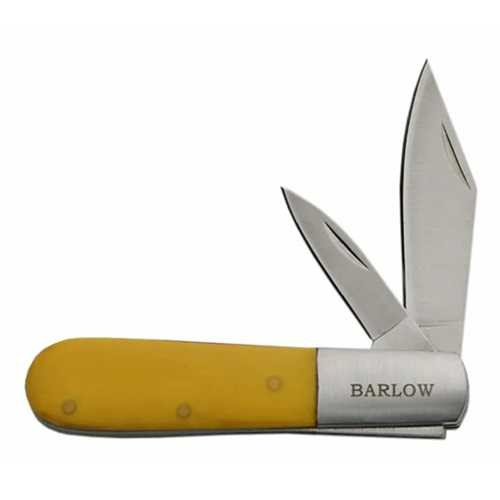
The Rite Edge Barlow Yellow Folding Pocket Knife takes a yellow composition handle, etched with the Barlow name at the bolster and holding a clip point and a wharncliffe blade, both stainless, in a knife that closes to 3.25 inches. Made in Pakistan.
A wharncliffe blade holds a straight edge that curves up sharply near the tip, keeping the point in line with the spine rather than dropping below it the way a clip point does. That shape gives more control for detail work like whittling or careful cuts, since the straight edge stays flat against a cutting surface longer than a curved blade would before lifting away. Pairing it with a clip point gives this Barlow more range than a single-blade pattern would offer, one edge for general everyday cutting and the other for controlled, precise work.
The long bolster remains the detail that sets any Barlow apart from other traditional patterns, extending well past the pivot rather than stopping at a standard bolster length, and it was originally meant to reinforce the pivot on an inexpensive working knife before becoming a stylistic hallmark of the pattern. Neither blade locks open, relying instead on spring tension in the frame the way traditional patterns have for generations. Both are opened by hand at the nail nick, a small notch cut into the blade rather than a stud or hole, keeping the profile clean while closed. Explore more Traditional Knives.