
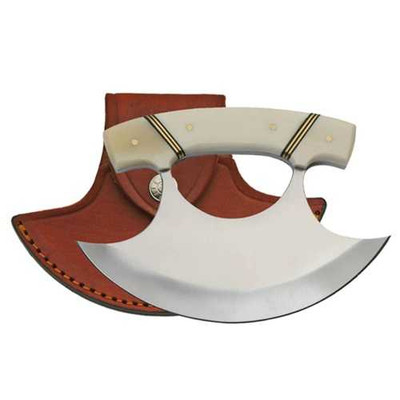
Solid Ulu Knife
Solid!
Fast shipping from Georgia

The Bone Handle Crescent Blade Kitchen Ulu Knife from Rite Edge holds a 5.5-inch satin-finished stainless crescent blade with full tang construction, set into a 4.5-inch smooth white bone handle, shipped with a leather sheath.
An Ulu is based on a curved, crescent-shaped blade rather than a straight edge, a traditional Inuit knife design meant for rocking cuts, pressing the blade down and rolling it forward through food or hide rather than dragging it across in a straight stroke. That rocking motion works especially well for mincing and chopping, and that is why the shape has stayed popular in kitchens well beyond its original Arctic use, where it was traditionally used for tasks like skinning, butchering, and even cutting hair. Full tang construction runs the steel up through the handle, giving the blade solid support at the point where most of the cutting pressure lands.
The bone handle sits above the curved blade rather than behind it the way a standard knife handle would, changing how the knife balances and how it's gripped compared to anything with a straight edge, closer to holding a small chopper than a typical paring or chef's knife. Bone as a material will show some natural variation in shade and grain from piece to piece, since it comes from an actual animal source rather than a dyed synthetic. Explore more Kitchen Knives.


